Understanding Antibiotic Recovery: Restoring Your Microbiome After Treatment
Dr. Chomba Chuma, MD & Founder
Founder, Velobiotics™
Antibiotics are essential for fighting infection, but they often leave your gut health in disarray. Discover how to effectively nourish your microbiome and reclaim your digestive balance after treatment.
Antibiotics are among the most important medical discoveries in human history. They save lives, prevent the spread of dangerous infections, and have transformed modern medicine. But here's something that doesn't get discussed enough in the average GP consultation: every course of antibiotics leaves a mark on your gut — and that mark can last far longer than most people realise.
As a physician and founder of Velobiotics™, I've spent years studying the relationship between pharmaceutical interventions and gut ecology. The science is clear. Antibiotic recovery is not passive. Your microbiome doesn't simply bounce back on its own schedule without support. Understanding why this happens — and knowing what to do about it — is one of the most practical things you can do for your long-term health.
This article is for anyone who has recently finished antibiotics, is currently taking them, or wants to be better prepared next time. We'll cover the science of microbiome disruption, evidence-based strategies for gut flora recovery, and the nutritional and supplementation tools that actually work.
What Happens to Your Gut During Antibiotic Treatment?
To understand recovery, you first need to understand the damage.
Your gut microbiome is home to an estimated 38 trillion microorganisms — bacteria, fungi, viruses, and other microbes that collectively regulate digestion, immunity, mood, metabolism, and more. These microbes exist in a carefully balanced ecosystem, shaped over your lifetime by diet, environment, genetics, and health history.
When you take antibiotics, that ecosystem is disrupted — often dramatically.
The Collateral Damage Problem
Antibiotics are not surgical tools. They are more like a controlled burn. Whether you're taking amoxicillin for a chest infection or ciprofloxacin for a urinary tract infection, the antibiotic doesn't distinguish between harmful pathogens and the beneficial bacteria that protect your gut lining, produce vitamins, and regulate your immune response.
Research published in Nature has demonstrated that even a short course of antibiotics can reduce microbial diversity by up to 30%, and in some cases, certain bacterial species may not return to pre-treatment levels for months or even years.
What Gets Wiped Out?
The casualties typically include:
- Lactobacillus and Bifidobacterium species — key players in digestive health and immune regulation
- Short-chain fatty acid (SCFA) producers like Faecalibacterium prausnitzii — critical for gut lining integrity
- Commensal bacteria that compete with opportunistic pathogens like Clostridioides difficile
This microbial depletion is precisely why so many people experience bloating, loose stools, fatigue, and even skin changes after antibiotic courses. These aren't minor inconveniences — they are signs of a disrupted internal ecosystem that requires active post-antibiotic health support.
How Long Does Antibiotic Recovery Actually Take?
This is one of the most common questions I receive, and the honest answer is: it depends.
A landmark study in Science tracked the microbiomes of 21 healthy adults following antibiotic treatment. While most participants showed signs of recovery within 1.5 months, a subset of individuals still had measurable dysbiosis — imbalance in microbial populations — at the 6-month mark.
Factors that influence recovery timeline include:
- Type and duration of antibiotic — broad-spectrum antibiotics (e.g., fluoroquinolones) cause more widespread disruption than narrow-spectrum ones
- Number of previous antibiotic courses — cumulative exposure compounds disruption over time
- Baseline gut diversity — a more diverse pre-treatment microbiome tends to recover faster
- Diet and lifestyle during and after treatment — heavily influences the speed and quality of microbiome restoration
- Probiotic supplementation — evidence suggests targeted probiotic use can significantly accelerate recovery
The takeaway? Don't assume your gut has simply "reset" after a week or two. Proactive restore gut after antibiotics strategies are essential.
The Science of Microbiome Restoration
Why Most Probiotics Fail to Deliver
Here's something that frustrates me both as a clinician and as a product developer: the probiotic industry is riddled with products that simply don't work as advertised. Most commercially available probiotics contain live bacteria — but those bacteria face a formidable gauntlet between the capsule and your colon.
Stomach acid, bile salts, and digestive enzymes destroy the majority of unprotected probiotic strains before they ever reach the gut. Studies suggest that standard probiotic formulations may deliver as few as 1 in 1,000 viable organisms to the large intestine.
This is the core problem that Velobiotics™ technology was designed to solve. BioGain™ uses microencapsulation technology that protects probiotic strains through the hostile environment of the upper GI tract, delivering up to 1,000 times more live bacteria to the gut compared to conventional supplements. When you're trying to actively restore gut after antibiotics, that difference in survivability is not trivial — it's the difference between a therapeutic dose and a wasted one.
Strains That Matter for Post-Antibiotic Recovery
Not all probiotics are created equal. When selecting a probiotic after antibiotics, look for evidence-based strains:
- Lactobacillus rhamnosus GG — one of the most studied strains, shown to reduce antibiotic-associated diarrhoea in multiple clinical trials
- Saccharomyces boulardii — a beneficial yeast that is naturally resistant to antibiotics and actively competes with pathogens
- Bifidobacterium longum — supports restoration of SCFA production and gut lining integrity
- Lactobacillus acidophilus — aids in recolonisation of the small intestine
A systematic review in the Cochrane Database found that probiotic use during and after antibiotic therapy reduced the risk of antibiotic-associated diarrhoea by approximately 51%. That's a clinically meaningful number.
Nutritional Strategies to Support Gut Flora Recovery
Probiotics alone are powerful — but they work best in a gut that is being actively nourished. Think of your microbiome as a garden. Probiotics plant seeds, but you still need to water the soil.
Feed Your Microbiome: Prebiotic Foods
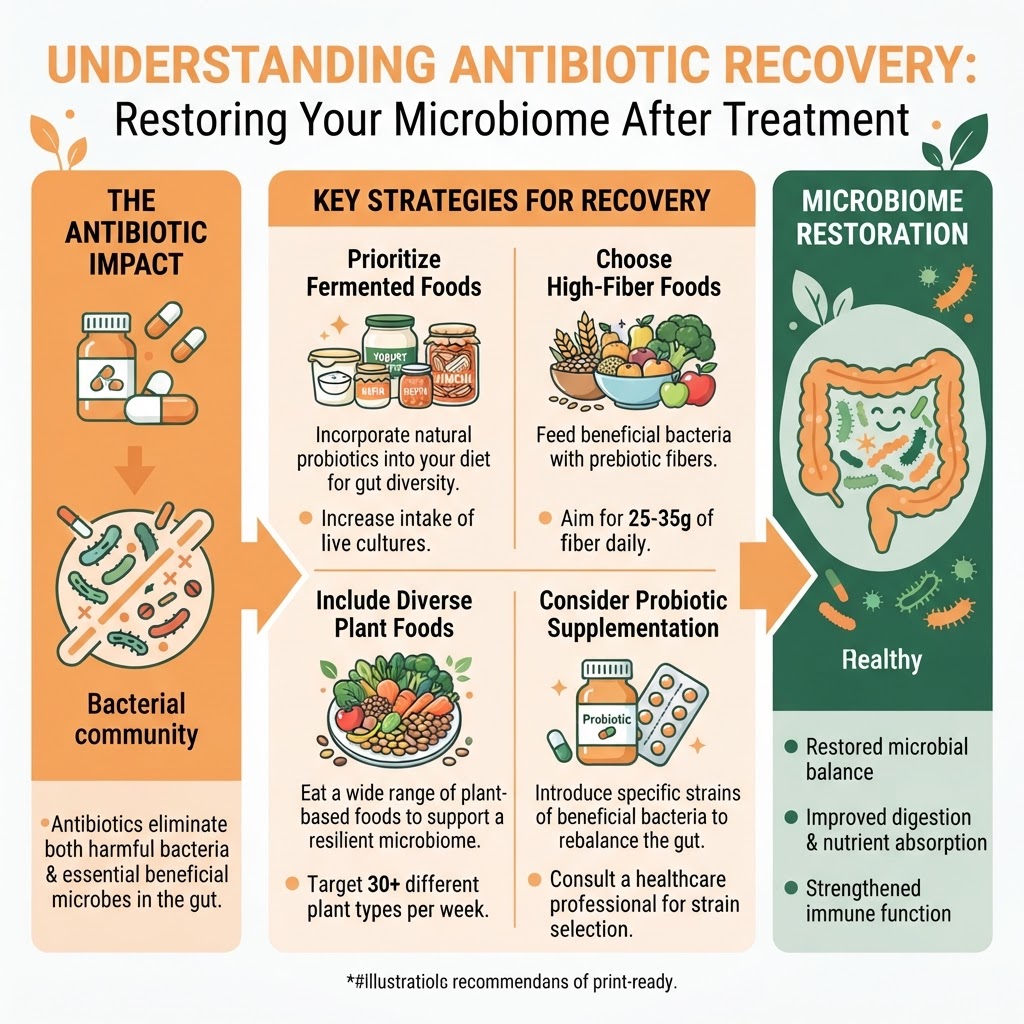
Prebiotics are non-digestible fibres that selectively feed beneficial bacteria. During gut flora recovery, prioritising prebiotic-rich foods accelerates the reseeding process:
- Garlic and onions — rich in inulin and fructooligosaccharides (FOS)
- Green bananas and plantains — contain resistant starch, a powerful microbiome fuel
- Jerusalem artichokes — among the richest sources of inulin
- Leeks and asparagus — gentle and well-tolerated prebiotics
- Oats — beta-glucan content supports both microbial diversity and immune function
Fermented Foods: Nature's Probiotics
Fermented foods deliver live cultures alongside a matrix of organic acids and bioactive compounds that support gut health:
- Kefir
- Sauerkraut (unpasteurised)
- Kimchi
- Natural yoghurt with live cultures
- Miso and tempeh
A 2021 study from Stanford published in Cell found that a high-fermented food diet significantly increased microbiome diversity and decreased markers of inflammation — even in the absence of probiotic supplementation.
Foods to Limit During Recovery
Just as important as what you add is what you reduce:
- Ultra-processed foods — disrupt microbial balance and reduce diversity
- Refined sugars — preferentially feed pathogenic species and Candida
- Alcohol — directly toxic to gut epithelial cells and suppresses beneficial bacteria
- Artificial sweeteners — emerging evidence suggests these alter microbial composition negatively
Practical Tips for Post-Antibiotic Recovery
This is where theory meets your daily life. Here's a clear, actionable protocol based on current evidence and my clinical experience:
During Antibiotic Treatment
- Take your probiotic at a different time than your antibiotic — ideally 2 hours before or after — to reduce direct antagonism
- Start prebiotics immediately — don't wait until the course is finished
- Eat fermented foods daily where tolerated
- Stay hydrated — antibiotic-associated diarrhoea depletes electrolytes rapidly
- Avoid alcohol entirely during the course — it compounds gut disruption and reduces antibiotic efficacy
Immediately After Finishing Antibiotics
- Continue your probiotic for at least 4 weeks post-treatment — ideally with a high-survivability formulation like BioGain™
- Introduce a diverse range of plant fibres — aim for 30+ different plant foods per week, as recommended by the British Gut Project
- Reduce ultra-processed food intake significantly for at least 4–6 weeks
- Consider bone broth — rich in collagen and glycine, which support gut lining repair
- Prioritise sleep — gut microbiome composition is strongly linked to sleep quality and circadian rhythm
Tracking Your Recovery
One of the most underutilised tools in post-antibiotic health management is simply monitoring. Many patients have no idea how they're progressing because they're not tracking anything.
Our free Recovery App was built specifically for this. Designed for post-surgery and recovery patients, it allows you to log daily symptoms, energy levels, bowel habits, sleep quality, and supplement adherence. When you can see your patterns clearly, you can make better decisions — and catch problems early.
The Gut-Immune Connection: Why Recovery Matters Beyond Digestion
I want to be clear that microbiome restoration after antibiotics isn't just about avoiding bloating or loose stools. The implications are systemic.
Approximately 70–80% of your immune system is housed in gut-associated lymphoid tissue (GALT). The bacterial species that inhabit your colon directly regulate immune cell development, cytokine production, and inflammatory signalling. When microbial balance is disrupted, immune function follows.
Emerging research connects poor post-antibiotic recovery with:
- Increased susceptibility to secondary infections
- Higher rates of allergic and autoimmune conditions in repeated antibiotic users
- Metabolic changes including altered insulin sensitivity
- Mood disturbances via the gut-brain axis — specifically through disruption of serotonin and GABA precursor production
This is why I recommend patients treat antibiotic recovery with the same seriousness they would give any prescribed rehabilitation programme.
Special Considerations: Children, the Elderly, and Frequent Antibiotic Users
Children
The paediatric microbiome is particularly vulnerable to antibiotic disruption. Early-life antibiotic exposure has been associated in observational studies with increased risk of asthma, obesity, and inflammatory bowel conditions. Paediatric probiotic use should always be discussed with a qualified clinician, but the general nutritional and dietary guidance above applies.
The Elderly
Microbiome diversity naturally declines with age. In older adults, antibiotic courses can cause more pronounced and prolonged dysbiosis. Prioritising prebiotic fibre and fermented foods, alongside well-formulated probiotic supplementation, is especially important in this population.
Frequent Antibiotic Users
If you've had three or more courses of antibiotics in the past two years, your baseline microbiome may already be significantly compromised. In this case, a structured recovery protocol — potentially including a more intensive nutrition overhaul — is warranted. Our Bulk-Up Plan includes a 30-day AI-powered gut-health focused nutrition framework that, while originally designed for muscle gain, is built on the same microbiome diversity principles that support deep gut flora recovery.
How BioGain™ Fits Into Your Recovery Plan
I won't oversell this, because the science speaks clearly enough. When you're working to restore gut after antibiotics, the single biggest supplementation challenge is probiotic survivability. Most products fail at this hurdle before they ever have a chance to help.
BioGain™ was formulated with Velobiotics™ microencapsulation technology specifically to address this. The result is a microencapsulated probiotic meal replacement that delivers viable, active cultures directly to the large intestine — where they're needed most — at a survival rate approximately 1,000 times higher than conventional probiotic formats.
It's also a meal replacement, which means it contributes to your overall nutritional intake during a period when appetite disruption and digestive sensitivity can make eating a challenge.
You can learn more about the formulation science at our science hub or explore product options at our product page.
Conclusion: Recovery Is an Active Process
Antibiotic therapy is sometimes unavoidable — and that's fine. These medications exist for good reason and, used appropriately, they do exactly what they're supposed to do. But the conversation doesn't end when you take the last tablet.
Your microbiome has been through a significant disruption. The research is unambiguous: without active, targeted support, full recovery can take months — and may be incomplete. With the right nutritional strategy, evidence-based probiotic supplementation, and consistent monitoring, you can meaningfully accelerate microbiome restoration and protect your long-term health.
The core principles are straightforward:
- Start probiotic support early, and continue it well beyond the end of treatment
- Prioritise prebiotic fibre and fermented foods
- Remove microbiome-disrupting foods temporarily
- Track your progress and respond to what you observe
If you're ready to take your post-antibiotic health seriously, I'd encourage you to explore what BioGain™ can offer — not as a magic fix, but as a clinically grounded tool that gives your microbiome a genuine fighting chance. Visit our recovery hub to access the full range of resources, or download our free Recovery App to begin tracking your wellness journey today.
Your gut built you. Take care of it.
Dr. Chomba Chuma, MD Founder, BioGain™ & Velobiotics™
Disclaimer: This article is intended for informational purposes only and does not constitute personalised medical advice. Always consult a qualified healthcare professional before making changes to your health regimen, particularly if you have a diagnosed medical condition or are currently undergoing treatment.
Get gut-smart, one email at a time
Science made simple, practical tips and member-only offers from BioGain. No spam, unsubscribe anytime.
By subscribing you agree to receive emails from BioGain (Velobiotics). Unsubscribe in one click.
Dr. Chomba Chuma, MD & Founder
Dr. Chomba Chuma is a medical doctor and the founder of Velobiotics™ and BioGain™. With a passion for gut health, recovery medicine and evidence-based nutrition, he created BioGain™ to bring clinically effective probiotic science to people who need it most — those healing, rebuilding, and performing at their peak.
Ready to Start Your Journey?
BioGain™ delivers 1000x more live probiotics to your gut with Velobiotics™ microencapsulation technology.